
The strategy to make hard choices.
The data to prove you made the right ones.
Why planning Can Fail
District strategic planning has a well-documented failure pattern.
Most planning processes produce impressive documents, but outcomes often don't match. The failure modes are not mysteries — they recur because the process itself can create the wrong incentives.
MPA's methodology, designed by leaders with economics and strategy expertise, and education practitioner experience, is designed to resist each of them.
Goal Proliferation
Accommodating every stakeholder's priorities results in a plan with 14 goals and no real choices — so nothing changes.
Consensus Theater
It's critical to surface what communities actually believe, but strategy that stops there and equate strategic choices with consensus, often miss what students actually need.
Process Over Outcomes
Commitments to "launch a committee" or "develop a framework" can risk substituting for targets that create accountability.
Historical Resource Inertia
Budgets simply follow last year's allocations — so the plan exists on paper while operations run on autopilot.
Data-Rich, Insight Poor
Districts collect more data than ever — test scores, enrollment trends, platform usage logs — but most of it sits in silos. Without dashboards that surface actionable patterns, and without the organizational habits to act on what the data reveals, more data just becomes more noise.
Why Choose MPA
What makes our engagements (both strategic planning and tech/analytics advisory) different from every other consulting firm.
01
Goal Proliferation
Accommodating every stakeholder's priorities results in a plan with 14 goals and no real choices — so nothing changes.
03
Methodology built around honest choices, not consensus documents
Our OKR-based goal architecture integrates best practices from the public and private sectors. It separates what students will achieve from what the district will do. Every strategy earns its place by meeting a credibility standard and requiring a real decision.
02
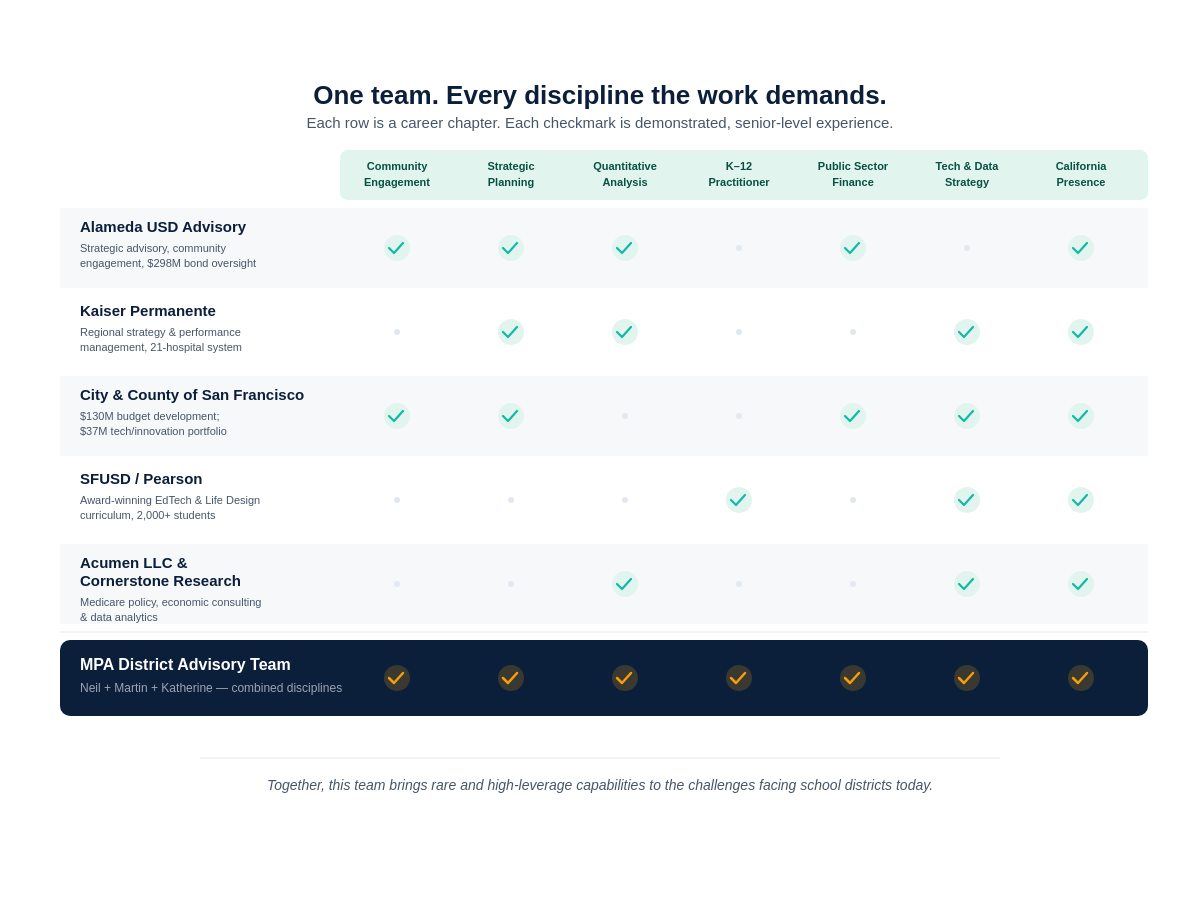
A multi-disciplinary team assembled for exactly this work
Strategic planning demands K-12 practitioner knowledge, including of innovation via partnerships. It also calls for rigorous analytical capability, community engagement skills, and executive judgment. MPA's team combines all four in one engagement.
04
Cost that reflects a lean senior model — not a staffed-up firm.
MPA's blended rate compares favorably with mid-tier consulting firms whose comparable engagements run up to 2x our cost — while delivering senior practitioners, not junior associates.
05
Technology & data strategy built on evidence — not vendor demos.
MPA brings the same rigor to tech and analytics decisions that we bring to strategic planning in general. We help districts evaluate EdTech investments against the peer-reviewed evidence, design structured pilots before committing to scale, and build the dashboards and data infrastructure that make progress visible (and accountability real). The binding constraint isn't the tech — it's the organizational system aound it.
Our methodology
A five-phase arc. Built to clarify purpose and drive impact
Every phase builds directly on the one before. Data informs community engagement. Community engagement informs strategic choices. These choices only become plans when they pass a coherence test.
Phase 1 — Diagnose
Data Foundation
- ·Environmental scan
- ·Enrollment & outcome trends
- ·Financial landscape review
- ·Prior plan assessment
Phase 2 — Listen
Community Voice
- ·Community forums (×3)
- ·Stakeholder focus groups
- ·Multilingual family surveys
- ·Student advisory panel
Phase 3 — Prioritize
Strategic Choices
- ·Diagnosis workshop
- ·Decision framework
- ·Evidence-backed strategies
- ·OKR goal architecture
Phase 4 — Build
Strategic Plan
- ·Resource alignment
- ·Goals & accountability systems
- ·Plan drafting & board adoption
Phase 5 — Track
Accountability & Growth
- ·Develop dashboard(s)
- ·Monitor & report progress
- ·Mid-year review & adjustment
- ·Capacity building & data fluency
What we deliver
Six integrated capability areas.
Every capability below is designed to work as part of a complete strategic engagement. For districts at a different stage — not in a planning cycle, or with a specific defined need — individual capabilities are available as standalone engagements.
Not currently in a planning cycle?
Several of our capability areas — including data analysis, stakeholder engagement, and analytics infrastructure — are available as standalone engagements. If your district has a specific need, we'll tell you honestly whether a focused engagement makes sense and what it would involve.
Tell us where you are →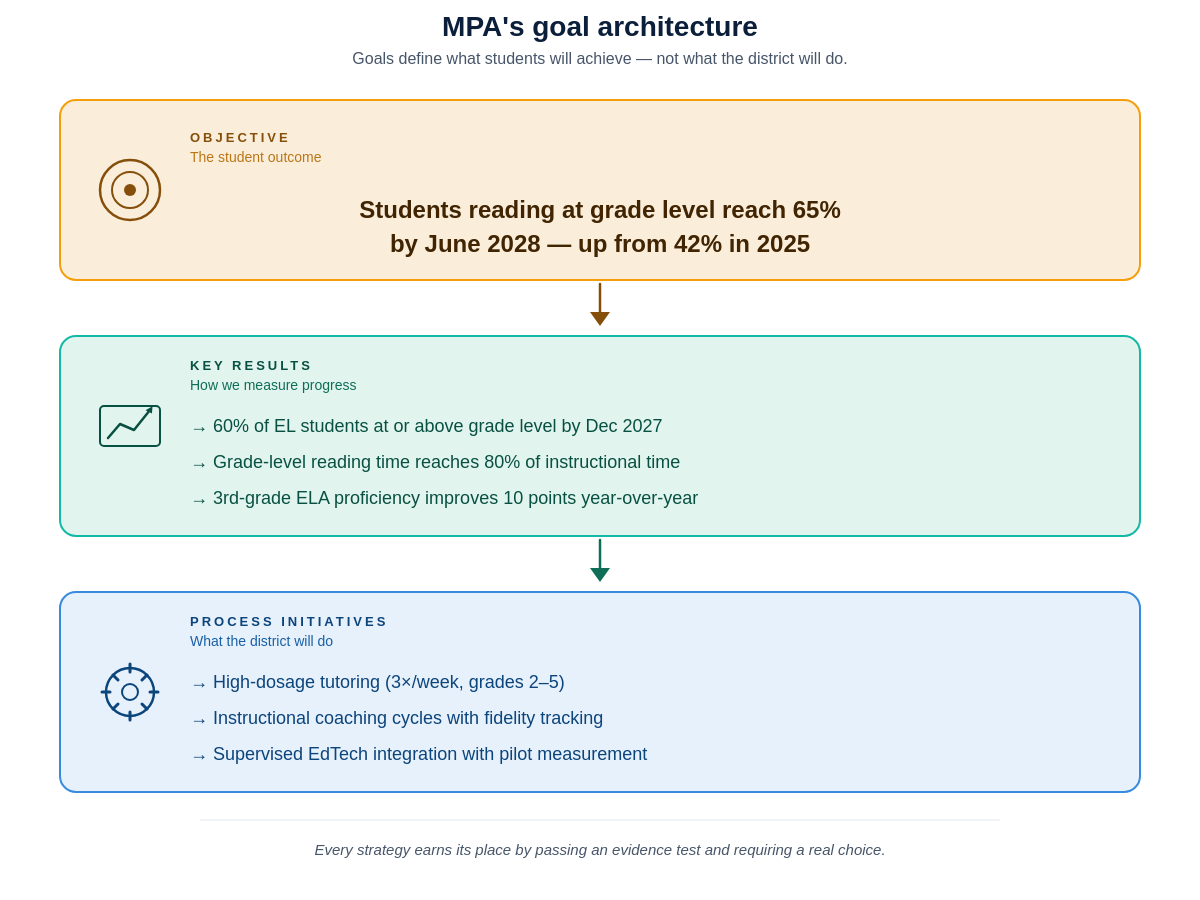
Demonstrated Impact
Work that's been trusted where it counts.
Case Study · 2023–2024
Strategic Advisory & Community Engagement — Alameda Unified School District
Alameda USD was navigating a proposed middle school closure — a high-stakes decision in a community where many families felt the process had moved forward without sufficient engagement or transparency. MPA was brought in to provide strategic advisory support and lead the community engagement process at a moment when district credibility was on the line.
MPA's analytical work included a root cause analysis of the district's enrollment challenge, a dynamic enrollment cost model showing marginal per-student costs at current and projected enrollment levels, an equity and IEP/504 outcome analysis revealing the school outperformed district peers academically while serving higher-needs students more efficiently, and a cost-benefit analysis modeling the financial implications of closure under multiple scenarios.
MPA presented findings directly to the Superintendent, Chief Business Officer, and full Board of Education — engaging each Board member individually to ensure the analysis was understood before any vote. Neil also spoke at a public town hall and a Board of Education meeting, ensuring community voices were represented alongside the analytical findings.
Neil has also served on Alameda USD's Bond Oversight Committee, advising district leadership and the full Board on prioritization and governance decisions across approximately $298M in infrastructure spending — bringing the same analytical rigor to capital planning that MPA applies to strategic planning.
Across both engagements, Neil provided the district leadership team with clear analytical frameworks for decisions that carried significant community and financial stakes. The strategic advisory and engagement process created genuine two-way dialogue — not managed consensus — helping the district navigate a complex political environment with its credibility intact.
200+
Community members engaged across forums and consultations
$298M
Infrastructure spending advised on via Bond Oversight Committee
4
Independent analytical frameworks delivered to district leadership
Equity & IEP/504
School outperformed district peers academically while serving higher-needs students more efficiently
The Team
Senior-led. Every engagement, every deliverable
MPA runs a lean senior model. The practitioners who propose this work are the ones who lead it — every strategic decision, every client-facing deliverable, every board presentation.



Tell us about your district's most pressing challenge.
We work with a small number of Bay Area districts at a time — whether you're in a full planning cycle, navigating a specific decision, or need better data infrastructure and analytics. Let's have a direct conversation.
Request a Consultation
We respond within one to two business days.